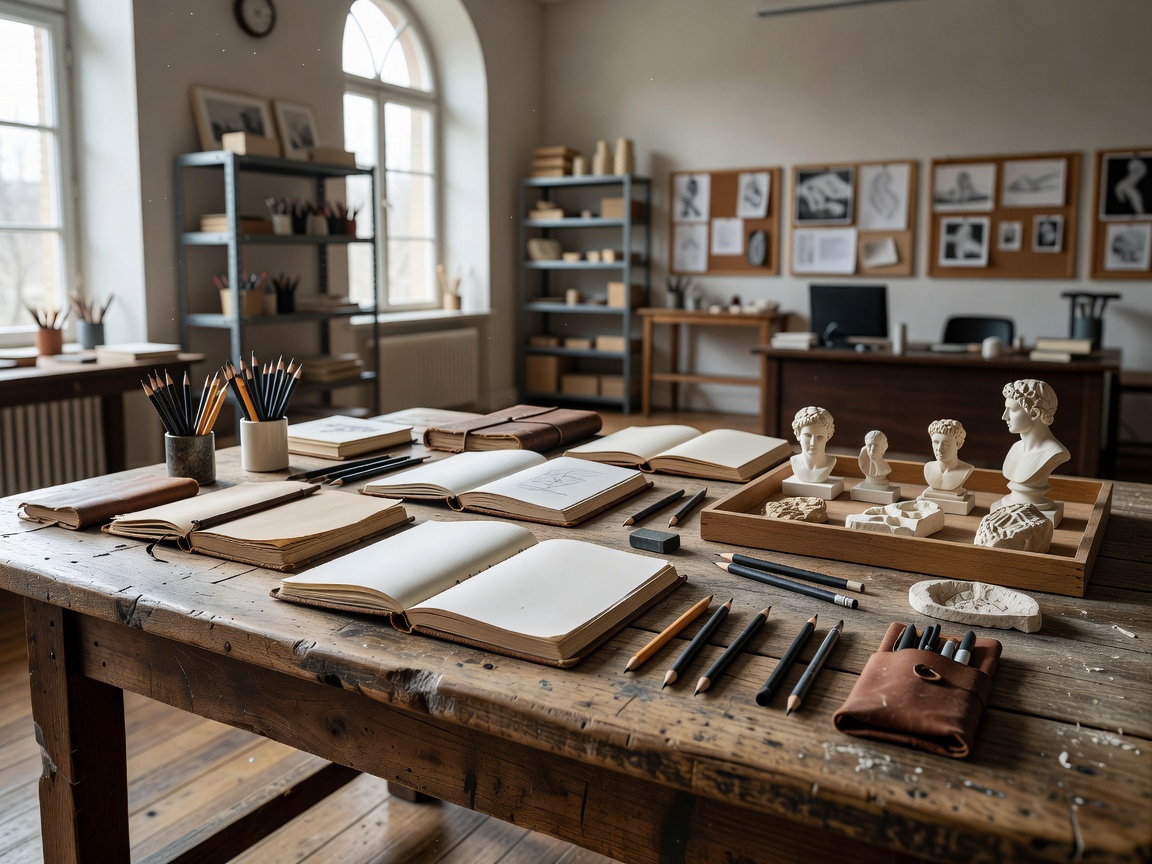
Museum workshops and activities can include making, demonstration, object handling where permitted, discussion or short creative tasks. The format name alone does not tell you whether a session fits. Compare the actual activity, audience, group conditions and learning purpose before planning around it.
What participants do
Creative workshops may use drawing, writing, construction or other ways to respond to a collection. Check whether the task is guided step by step or open-ended, whether participants keep their work and what materials are supplied. Art activities can focus on process, interpretation or a particular technique; confirm what the session actually involves.
Object handling should only be expected when the museum explicitly says it is part of the program. Some sessions use handling collections or replicas; others keep objects in cases. Ask what participants may touch, what supervision applies and whether an alternative activity is available for someone who does not wish to handle materials.
Demonstrations place attention on a process, technique or interpretation presented by a facilitator. They can work for groups who prefer to watch before trying something, but participation may be limited by visibility, room layout or group size. Ask where participants sit or stand and whether questions are included.
Discussion sessions use questions, comparison and shared interpretation. They may take place in a gallery or learning room. Check whether participants are expected to speak, work in pairs or respond in writing. Short-format programs can fit a compact visit but may leave little time for settling, transitions or reflection.
Compare the practical details
Start with duration. Confirm the active program time, arrival instructions, introduction, cleanup and any break. A session listed as one hour may require additional time on site. Build in a margin for group movement and late arrivals.
Ask about group size, including whether the class or visiting party will be divided. Smaller groups may allow more individual participation, while splitting a group can require extra adults, space or scheduling. Confirm supervision responsibilities rather than assuming the facilitator replaces accompanying adults.
Check materials and room arrangements. Some activities involve wet or dusty materials, tools, storage, aprons or a place to dry work. Ask whether participants need to bring anything, whether materials are included in the session, and what the museum allows visitors to carry into galleries.
Confirm the age level and how instructions are adapted. A broad age range may mean different levels of challenge or simply a shared activity. Request the stated learning objectives and ask what prior knowledge is assumed. Objectives help you decide whether a workshop connects to your group’s purpose; they do not guarantee a particular result.
Finally, consider participation level and facilitator involvement. Is the session mainly demonstration, guided making, independent work or a balance? Can participants pause, observe instead of making, or contribute in another way? These details matter for confidence, communication and access.
Plan the learning context
A workshop can stand alone or connect a practical task to objects, histories, science concepts or artistic choices. Ask how the collection informs the activity. If the session takes place in a separate room, check whether there is gallery time before or afterwards and whether transitions are included in the schedule.
For classroom planning, identify one preparation prompt and one follow-up activity. A simple pre-visit observation task can give participants a shared starting point. After the visit, invite them to compare their making choices with something they observed. Keep follow-up proportionate; the activity should support your teaching plan rather than create unnecessary extra work.
GOOD FOR
Groups seeking a defined practical task, a demonstration of process, focused conversation or a short participatory element within a wider visit. Suitability depends on the activity’s duration, age range, group size and participation options.
WHAT TO CHECK
- Exact activity, duration, group size and age guidance.
- Materials, cleanup, room location and whether work can be taken away.
- Facilitator role, supervision expectations and opt-in alternatives.
- Learning objectives, collection connection and access arrangements.
TRADE-OFFS
Hands-on making adds active work but takes time and may involve materials or cleanup. Demonstrations can show process efficiently but may offer less individual practice. Discussion can support multiple interpretations but needs a room setup that lets everyone hear and contribute. Short sessions reduce time commitment but also reduce room for settling, breaks and follow-up. Check the program outline rather than choosing by title.
See School Museum Programs for class visit formats and Object-Based Museum Learning for structured collection inquiry.