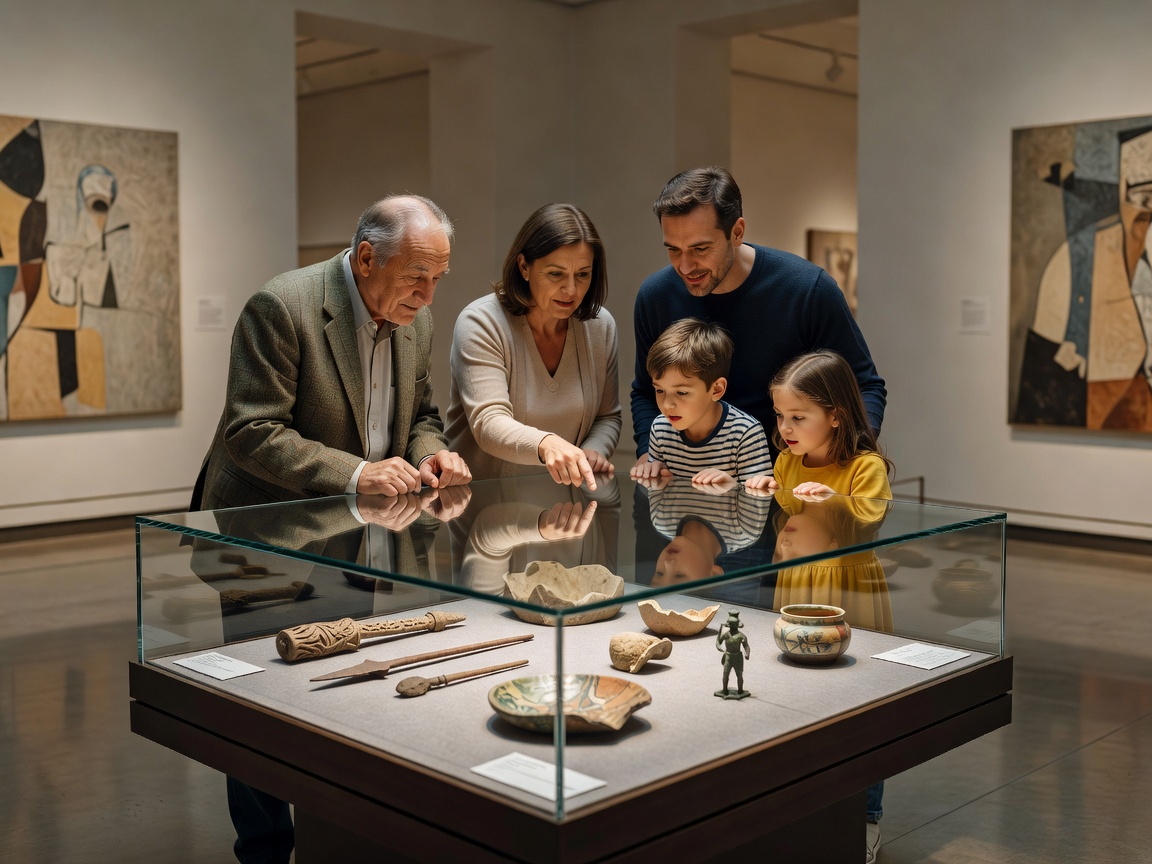
Family museum learning is not limited to a scheduled class. It can happen through a facilitated session, a small activity prompt, a discovery station or an unhurried conversation beside an object. The useful planning question is how much structure the group wants and what will help participants choose their own level of involvement.
Make space for intergenerational participation
Adults and children can notice different details, bring different experiences and respond at different speeds. A useful family activity gives everyone a way into the subject without asking one age group to do all the work. Look for clear instructions, open-ended prompts and opportunities to talk, draw, compare or simply observe.
Child-friendly interpretation does not mean reducing every subject to a simple answer. It can mean shorter blocks of information, legible labels, concrete prompts and choices about what to explore. Ask what age range the activity is designed for. If children will be at very different developmental stages, check whether the format can be adapted or approached in more than one way.
Parents and guardians may act as readers, conversation partners, practical helpers or observers. The format should make these roles understandable without requiring adults to have specialist knowledge. Check whether adults need to stay with children throughout and whether all family members need to register for a scheduled activity.
Compare the main formats
Structured family sessions have a planned start, facilitator and activity sequence. They can provide a clear shared focus, but a fixed start time and pace may be difficult for families with variable arrival times or energy.
Drop-in activities usually allow arrival within a stated window and participation for a shorter period. They suit flexible visits, although availability, materials and facilitator presence can vary. Ask whether the activity is staffed throughout and whether queues or limited workspaces may affect the experience.
Self-guided family exploration lets each household choose its route. A map, prompt card or digital guide can offer structure without requiring a scheduled session. Families need to manage pace and interpretation themselves, so check whether instructions are easy to find and use.
Workshop formats reserve time for a practical task, discussion or making activity. They may hold attention through active participation, but often involve a fixed duration, defined age range or materials that require handling. Ask whether participants can take breaks or leave and return.
Plan a realistic pace
Children may want to stay with one object or move quickly through several rooms. Plan for both possibilities. Identify a small number of places to visit rather than treating every gallery as a required stop. Check the location of seating, toilets, food areas and quieter spaces. A break is a practical part of visit planning, not a failure to complete an activity.
Ask how long a session lasts and whether that includes arrival, introductions and cleanup. For independent exploration, choose a visit window that leaves room for pauses. Pack only what the museum permits; food, drink, strollers and drawing materials may be subject to site rules.
Access and independent choice
Family groups can include different mobility, sensory, communication and attention needs. Do not assume a child or adult will want the same level of participation as another family member. Offer choices: speak, point, draw, listen, take a pause or skip an activity. Before visiting, ask the museum about routes, seating, sensory conditions, accessible toilets, communication supports and available learning materials. Details are site-specific and should be confirmed directly.
Independent exploration works better when the group knows how to regroup and where to find help. Agree a simple meeting point and a plan if someone needs space. Check whether family activity materials are available in print, large type or another format that suits the group.
GOOD FOR
Mixed-age visits, shared curiosity, low-pressure exploration and families who want different ways to take part. A drop-in or self-guided option may work for flexible timing; a scheduled session may suit families looking for a shared focus.
WHAT TO CHECK
- Age range, start time, duration and registration rules.
- Whether adults participate and whether children remain with guardians.
- Break options, seating, toilets and activity-material arrangements.
- Access information, sensory details and alternative ways to participate.
TRADE-OFFS
Structured sessions offer facilitation but reduce spontaneity. Drop-ins reduce timetable pressure but may have variable staffing or capacity. Self-guided routes provide choice but ask families to set their own pace. Workshops add making or focused discussion and can require sustained attention. Choose by the family’s practical needs, not by an assumption that one format suits every household.
For organized school visits, see School Museum Programs. For flexible participation planning, read Accessible Museum Education.